Alzheimer’s Disease: From Earlier Diagnosis to Deeper Molecular Understanding

This year’s World Alzheimer’s Day theme from Alzheimer’s Disease International is “The Earlier You Know, The More You Can Do: A Dementia Diagnosis Matters”. Earlier diagnosis puts more people within reach of treatment and trials, and ADI’s 2026 World Alzheimer Report focuses on clinical trials. The scale is large: more than 55 million people live with dementia worldwide, and an estimated 7.4 million people aged 65 and older live with Alzheimer’s dementia in the US, a number that could reach 13.8 million by 2060 absent medical breakthroughs.
A number that could reach 13.8 million by 2060 absent medical breakthroughs.
That raises a practical question for research. With a pipeline this broad, which mechanisms deserve testing next? To see what mechanism level analysis of Alzheimer’s data can add, we ran a public dataset through geneXplain’s Genome Enhancer and read the output against the 2026 landscape.
The Alzheimer’s Research Landscape in Brief
Diagnosis Is Moving Toward Blood-Based Biomarkers
One of the most significant developments in Alzheimer’s research is the rapid progress in blood-based biomarkers.
At AAIC 2026, Roche presented data on its CE-marked Elecsys pTau217 test in primary and secondary care. Findings from Swedish clinics also showed that introducing a blood test could influence both diagnosis and subsequent disease management.
Among these biomarkers, phosphorylated tau, particularly p-tau217, is emerging as an important indicator of Alzheimer’s pathology. NIH-supported research has shown that blood-based p-tau217 measurements can identify Alzheimer’s related pathology with high accuracy, potentially providing a more accessible first step than PET imaging or cerebrospinal fluid testing.
Research is now moving even further upstream. Findings presented in 2026 suggest that p-tau217 may help identify an increased risk of cognitive impairment years before symptoms appear. However, the clinical use of such testing in people without symptoms still requires careful validation and interpretation.
Treatments Are Advancing, but Important Limitations Remain
Treatment progress has been more gradual. Lecanemab (Leqembi) and Donanemab (Kisunla) are intravenous monoclonal antibodies that slow cognitive decline in early stage Alzheimer’s disease by clearing amyloid buildup in the brain.
However, these therapies do not stop or reverse the disease, highlighting the continued need to understand the broader biological mechanisms that drive Alzheimer’s progression.
Alzheimer’s Research Is Moving Beyond a Single Target
Amyloid and tau remain central to Alzheimer’s biology, but the therapeutic landscape is becoming increasingly diverse.
The 2026 Alzheimer’s drug development pipeline includes 158 drugs being evaluated across 192 clinical trials. Researchers are investigating at least 17 different categories of disease biology, including:
- inflammation and immune dysfunction
- metabolism and bioenergetics
- synaptic function
- oxidative stress
- APOE and lipid biology
- vascular processes
- protein homeostasis
- amyloid and tau pathways
Around 35% of drugs in the current pipeline are repurposed agents.
This diversification reflects an increasingly important view in Alzheimer’s research: the disease is unlikely to be fully understood through a single molecule or pathway alone.
The Next Question: What Is Driving the Molecular Changes?
Omics studies can identify hundreds or even thousands of genes whose activity changes in Alzheimer’s disease. However, a list of differentially expressed genes does not necessarily explain why those changes occurred or which mechanisms may be driving them.
A useful next step is therefore to move from:
This systems level approach can help researchers move beyond describing disease associated changes and generate experimentally testable hypotheses about the upstream molecular processes that may be driving the observed disease signature.
Case Study: Looking Upstream of Aβ-Induced Gene Expression Changes
A useful example of this systems level approach comes from the analysis of GSE144194, a publicly available transcriptomic dataset investigating the effects of intracellular amyloid beta (Aβ) toxicity in human MC65 nerve cells.
MC65 cells provide an experimental model in which expression of the C99 fragment of amyloid precursor protein (APP) can be induced by removing tetracycline. C99 is subsequently converted to Aβ, leading to intracellular Aβ accumulation. In the original study, cells were collected two days after Aβ induction before overt cell death allowing researchers to examine some of the molecular changes that occur during the early cellular response to Aβ toxicity.
The original study showed that intracellular Aβ produces extensive molecular alterations associated with oxidative stress, mitochondrial dysfunction, metabolic reprogramming and oxytosis/ferroptosis, a form of regulated cell death linked to lipid peroxidation. These findings make the dataset useful for investigating mechanisms that may contribute to Aβ-associated neuronal stress, while it is important to recognize that this is a cellular model relevant to Alzheimer’s disease rather than patient-derived Alzheimer’s brain tissue.
Moving beyond differentially expressed genes
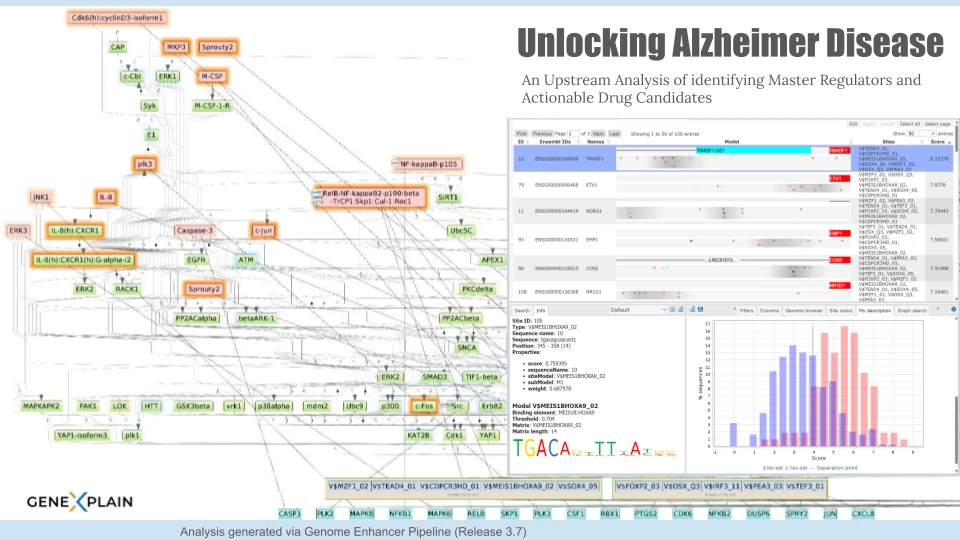
Genome Enhancer was applied to the transcriptomic data to ask a different question: rather than looking only at which genes change after Aβ induction, what regulatory mechanisms might be driving those changes?
In the Genome Enhancer reanalysis, 1,424 genes showed increased expression and 1,641 showed decreased expression using a log2 fold change threshold of ±0.5. Of these, 108 upregulated and 31 downregulated genes met the report’s nominal p-value threshold of p < 0.01. Among the strongly upregulated genes were CXCL8, HMOX1, PTGS2, EGR1, DUSP6, FOS and JUN, several of which are associated with inflammatory, oxidative stress and stress response pathways.
Using a log2 fold change threshold of ±0.5. Of these, 108 upregulated and 31 downregulated genes met the report’s nominal p-value threshold of p < 0.01.
These expression changes represent the observable molecular response, but they do not necessarily reveal which regulatory events initiated or coordinated that response.
Identifying transcription factors behind the expression signature
The next step was therefore to examine the regulatory regions of the differentially expressed genes.
Using transcription factor binding motifs from TRANSFAC the analysis searched for combinations of transcription factor binding sites that were enriched in the regulatory regions of the affected genes.
This analysis highlighted several transcription factors as potential regulators of the observed gene expression programme. Among the most prominent were:
Among the most prominent were
These transcription factors are not simply genes that happened to change expression. Rather, the computational analysis suggests that their regulatory activity may help explain the coordinated expression changes observed across a much larger group of genes.
This illustrates an important distinction in omics interpretation: the genes showing the largest expression changes are not necessarily the molecules driving the biological response.
Moving further upstream to signaling networks
Once potential transcription factors had been identified, the analysis moved another level upstream.
Using signaling relationships represented in TRANSPATH, Genome Enhancer reconstructed networks connecting upstream signaling molecules with the transcription factors implicated in the Aβ-associated expression pattern.
Among the highest ranked candidate master regulators were PTGS2/COX-2 and PLK3. In the Genome Enhancer model, these molecules occupy upstream positions from which changes in signaling could potentially influence transcription factors and, consequently, larger groups of downstream genes.
Among the highest ranked candidate master regulators were
PTGS2 is particularly interesting in the context of this dataset because it was also one of the strongly upregulated genes in the transcriptomic analysis. The original GSE144194 study independently reported increased oxidation of arachidonic acid derived lipids and activation of pathways associated with oxidative stress and oxytosis/ferroptosis following Aβ induction. This does not experimentally establish PTGS2 as a master regulator of Alzheimer’s disease, but it provides biological context for why an upstream network analysis might highlight this molecule.
PLK3 emerged separately from the reconstructed signaling network as another candidate upstream regulator. Its identification should therefore be viewed as a computational hypothesis generated from the network structure and expression data, rather than as an experimentally validated Alzheimer’s target.
From regulatory mechanisms to testable hypotheses
The analysis then assessed the predicted master regulators for their potential druggability using information from HumanPSD and cheminformatics predictions.
Several compounds were computationally associated with the identified targets, including molecules already investigated in clinical or experimental settings and others suggested through drug repurposing analysis. The report ultimately highlighted compounds such as curcumin, niclosamide, hyperforin and bortezomib for further investigation, while additional compounds were linked specifically to PTGS2 and PLK3.
These results should not be interpreted as treatment recommendations. They represent hypotheses for further experimental validation, generated by connecting transcriptomic changes with regulatory networks, potential molecular targets and existing drug target knowledge.
What does this case study tell us?
The value of this type of analysis lies less in producing another list of Alzheimer’s associated genes and more in building a possible mechanistic chain:
In this example, transcriptomic data that initially describe thousands of expression changes can be reduced to a smaller set of regulatory hypotheses that researchers can investigate experimentally.
Importantly, PTGS2/COX-2 and PLK3 should be considered candidate regulators identified by the computational model not established drivers or therapeutic targets for Alzheimer’s disease.
That distinction is central to how systems biology can contribute to complex diseases such as Alzheimer’s: not by claiming that a single analysis has identified the answer, but by helping researchers move from large descriptive datasets toward specific, biologically interpretable and experimentally testable questions.
Read the full report
“PTGS2 and PLK3 are promising druggable targets for treating Alzheimer Disease that control activity of CUX1, IRF3 and FOXO1 transcription factors on promoters of differentially expressed genes” — the complete Genome Enhancer analysis of GSE144194.
Read the full reportFrom detection to mechanism
The progress in Alzheimer’s research is encouraging. We are getting better at detecting biological changes earlier, clinical pipelines are becoming more diverse, and increasingly sophisticated molecular datasets are available to researchers.
But earlier detection is only part of the challenge.
The next step is to connect biomarkers and omics observations with the regulatory networks that drive disease progression and then determine experimentally which of those mechanisms can actually be modified.
Combining early biomarkers, multi-omics data, regulatory network analysis and well designed clinical studies may help turn increasingly rich Alzheimer’s datasets into more precise biological hypotheses, and ultimately new opportunities for diagnosis and treatment.
On World Alzheimer’s Day, the message for research is therefore not only “detect earlier,” but also “understand deeper.”