TRANSFAC Expert — we do it with you
Describe your target or disease. We’ll tell you what’s driving it, and will prove it.
No software to learn. No raw data to wrangle. Our scientists work alongside your team from biological questions to mechanistic insight, target prioritization and experimental validation. We will trace the signal from altered genes to transcription factors, upstream pathways, master regulators and druggable control points. We rank the targets that actually matter, and hand you a clear mechanistic answer that can be validated in a lab, with a named expert behind it. Your data and any resulting IP stay yours.
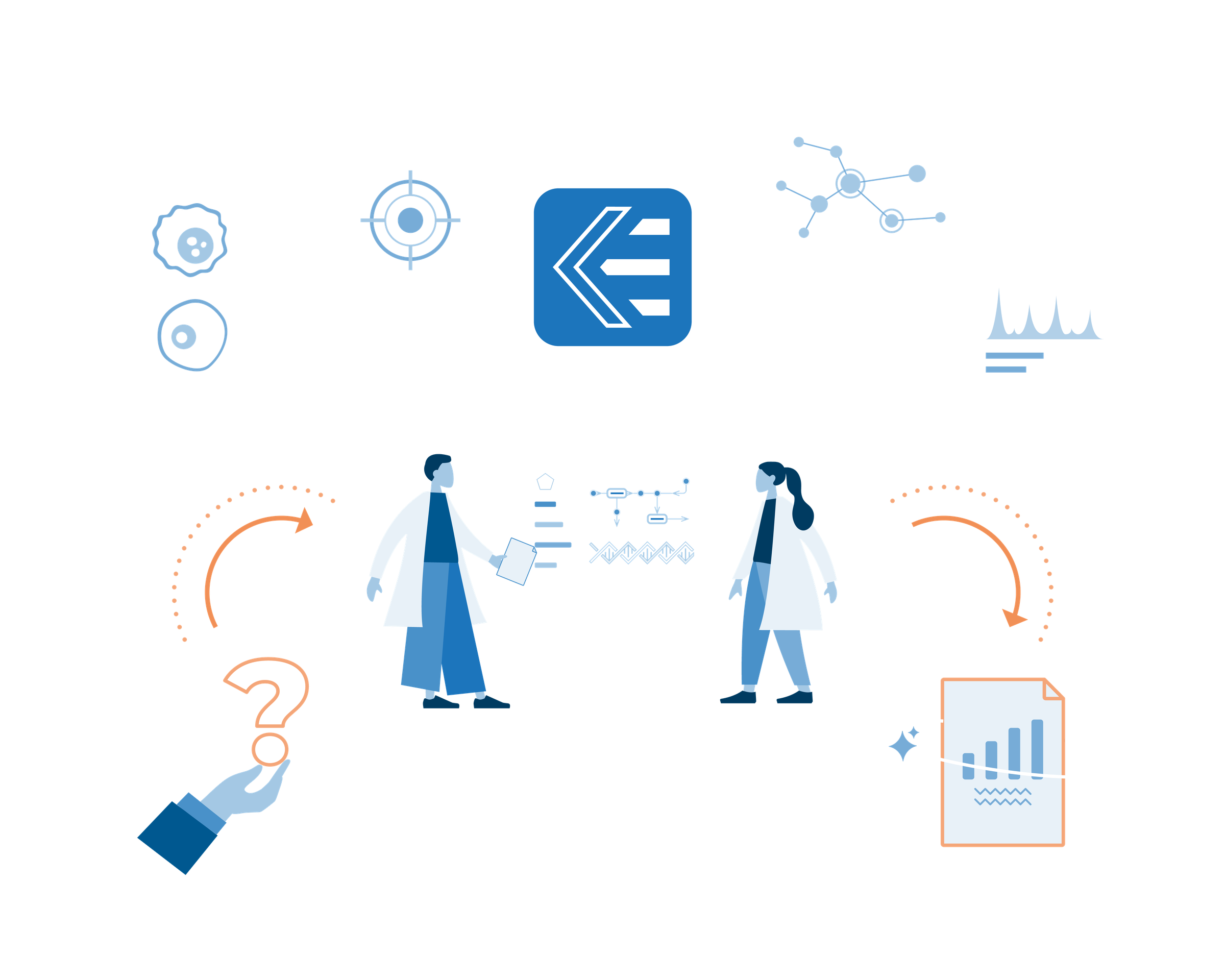
You bring
“Here’s the data. Here’s the disease. We don’t know what’s driving it.”
We scope it
One call, then a defined engagement, priced case by case, with IP and data terms agreed up front.
You get back
A ranked, mechanistically justified answer, traceable to the evidence, with a named scientist who stands behind it, and optional wet lab validation.
Pay on success
A low starting fee, the rest only when results get validated.
50+
Funded R&D projects delivered (EU · BMBF · national grants)
30+
Disease mechanisms of action uncovered
3
Drugs repurposed to new indications
1
Novel anti-cancer drug lead preclinically validated
100%
Of results and IP stay with you
Antibiotic repurposed as an anti-IBD drug — a trial is planned
geneXplain applied its Upstream Analysis technology to IBD data from patients, organoids, xenografts, and immune cells to reconstruct disease-driving NF-κB regulatory networks, identify master regulators and drug targets, and prioritize compounds for repurposing. This led to the prediction of clarithromycin as a potential anti-IBD agent, later validated in vitro and in vivo.
What can TRANSFAC Expert help you to solve?
Disease Mechanisms & Master Regulators
Understand what drives a disease phenotype and identify regulatory intervention points.
Disease networks · TFs · Upstream pathways · Master regulators · Target prioritization
Treatment Response & Resistance
Explain non-response, acquired resistance and pathway rewiring.
Resistance drivers · Master regulators · Combination hypotheses · Biomarkers
Drug Mechanism of Action & Toxicity
Understand desired and adverse molecular effects of a compound.
MoA · Toxicity mechanisms · On/off-target effects · Safety biomarkers
Promoter & Regulatory Element Design
Design tissue-, cell- or condition-specific regulatory constructs.
Promoter grammar · TF combinations · Enhancers · Candidate constructs
Cell & Gene Therapy
Support CRISPR, CAR-T/CAR-NK and regulatory cassette development.
Target selection · Regulatory logic · Tissue risks · Intervention strategy
Biomarkers & Patient Stratification
Turn complex molecular signatures into mechanistically justified biomarker concepts.
Biomarker ranking · Subtype mechanisms · Minimal panels · Validation strategy
AI & Biomedical Knowledge
Ground biomedical AI in curated regulatory and mechanistic biology.
Knowledge graphs · Curated relations · AI-ready knowledge · Mechanistic reasoning
Don’t see your exact question?
TRANSFAC Expert is designed for non-routine projects.
What you can bring to TRANSFAC Expert?
Start with what you already have.
Transcriptomics
Bulk RNA-seq · single-cell RNA-seq · spatial transcriptomics · microarrays
Epigenomics
DNA methylation · ATAC-seq · ChIP-seq · regulatory regions
Genomics
Variants · mutations · candidate loci · gene lists
Proteomics
Protein abundance · phosphoproteomics · protein signatures
Metabolomics
Metabolites · metabolic signatures
Drug & Perturbation Data
Treatment response · CRISPR · knockdown · screening results
Clinical & Phenotypic Data
Responders/non-responders · disease subtypes · clinical characteristics
Existing Results
DEGs · pathways · targets · biomarkers · hypotheses from your internal team or AI models
Your data do not need to be analysis-ready. Sometimes the first TRANSFAC Expert task is to determine what information is already sufficient, what additional analysis is useful, and which experiment should come next.
What comes back, on real data
Sometimes you don’t need yet another data analysis. You need another expert thinking about the problem.
Routine bioinformatics can identify altered genes, enriched pathways and statistical associations. But that often leaves the most important questions unanswered:
Why did this happen?
What mechanism is driving it?
Which candidates matter most?
What should we test next?
That is where TRANSFAC Expert begins.
geneXplain scientists work directly with your team to turn complex molecular results into prioritized, mechanistically justified hypotheses and clear next steps.
”
“We have the results. What do we do next?”
A list of differentially expressed genes is not a research strategy. We help connect the observed changes to regulatory mechanisms and define the next experiment.
”
“We have too many candidates.”
We reduce long lists to a focused set of targets, master regulators or biomarkers supported by causal regulatory biology.
”
“Our analyses are fragmented.”
We connect gene regulation, signaling pathways, disease mechanisms and targets in one coherent scientific interpretation.
From data to decision — with a named expert who stays involved in the project.
Go upstream from what changed to what is driving it.
Standard omics analysis usually starts with altered genes and moves downstream to pathways, functions and enrichment results.
This is useful for describing what has changed.
TRANSFAC Expert goes upstream. Our Upstream Analysis traces altered gene activity back through the regulatory mechanisms that may have caused it.
Omics changes → promoters & enhancers → transcription factors → signaling pathways → master regulators → actionable targets
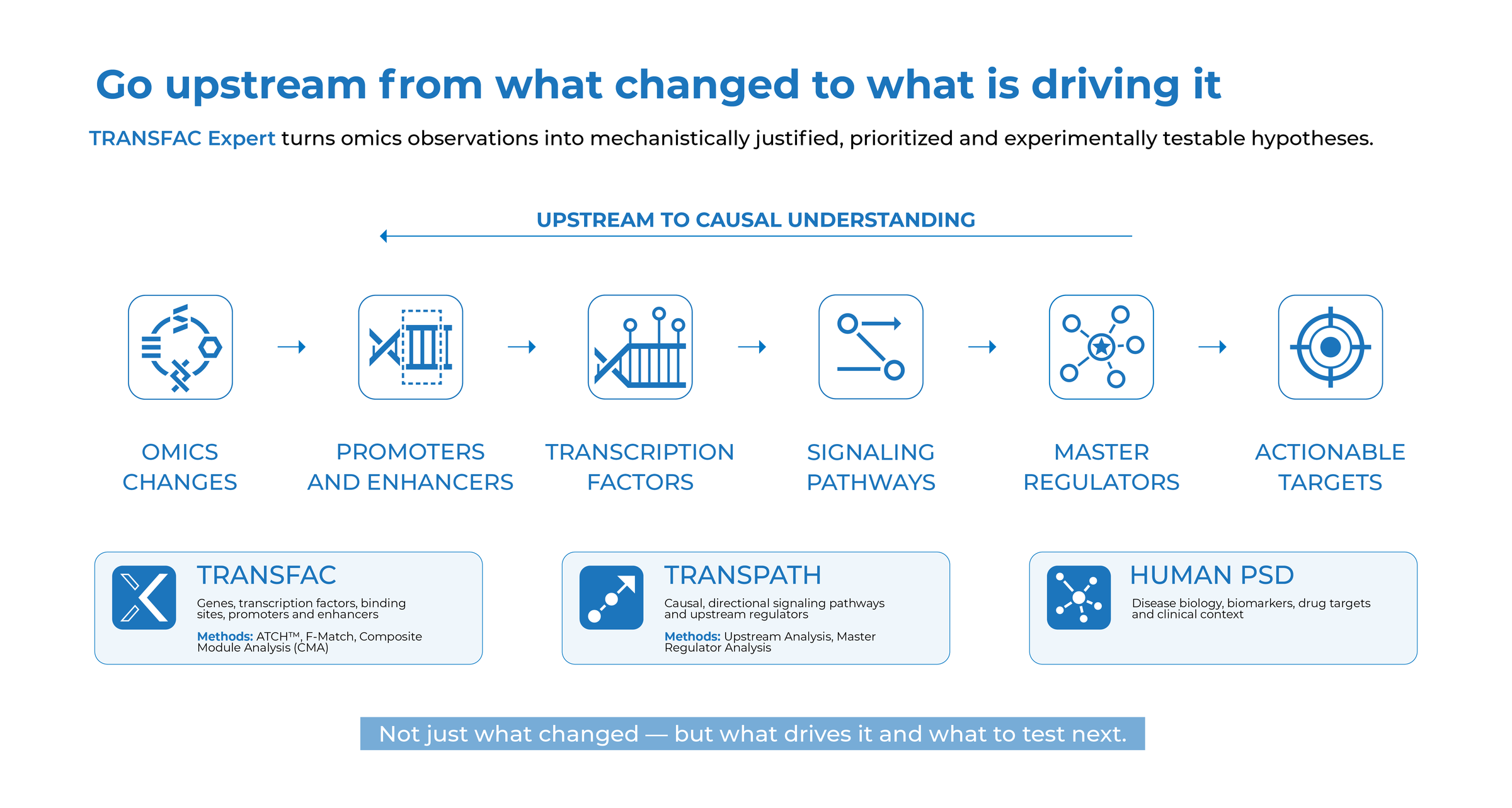
Click to open the diagram full size.
What that is enabled by
geneXplain’s unique curated knowledge and proprietary analysis methods.

TRANSFAC
Connects genes with transcription factors, binding sites, promoters and enhancers. Algorithms such as MATCH, F-Match and Composite Module Analysis (CMA) identify enriched transcription factors, regulatory motifs and combinations of transcription factor binding sites that may explain the observed gene-expression program.

TRANSPATH
Provides curated, causal and directional signaling reactions. Our Upstream Analysis and Master Regulator Analysis trace regulatory signals from transcription factors through signaling pathways to receptors, kinases and other upstream control molecules, helping identify key regulators that may drive the phenotype.

HumanPSD
Connects these reconstructed mechanisms with disease biology, biomarkers, drug targets, drugs and clinical context.
The goal is not another gene or pathway list. It is to answer the questions that determine the next experiment:
What is driving the observed molecular changes?
Which master regulators control the phenotype?
Which targets are most promising to test next?
That is the core of TRANSFAC Expert: turning omics observations into mechanistically justified, prioritized and experimentally testable hypotheses.
Where integrated knowledge from TRANSFAC, TRANSPATH and HumanPSD was applied to reveal disease molecular mechanisms
Bring us the problem a standard pipeline can’t solve.
Anyone can run a standard pipeline and guarantee a reproducible result, for a few hundred dollars. We can do more. Our work is the non-routine, inventive part: the disease no one has mapped, the resistance no one can explain, the target no one else will commit to.
Fifty funded research projects, many at the frontier of science and genuinely inventive, are the track record behind that.
A model can generate a conclusion. It can’t take responsibility for one.
In a regulated pipeline, “the model said so” is not an answer. Someone has to stand behind the science: read the evidence, defend the call, and be reachable when it matters.
“The same DNA sequence is controlled by different transcription factors in different cell types. A model that pattern-matches will miss that. A person who knows the biology won’t.”

Prof. Dr. Alexander Kel
CEO & CSO, co-author of TRANSFAC
Every done-for-you engagement is built around a named scientist who scopes the question, runs the analysis, and is accountable for what comes back — not an automated report with no author. For teams that have to defend a conclusion downstream, that’s often the whole point of the engagement.
The results are yours, and we put that in writing.
Your IP stays yours
Any target, biomarker or discovery from the work belongs to you — stated explicitly in the contract, on your terms. Where it helps, we’ll go as far as structuring the work through a separate entity you control (the model large pharma has used for exactly this).
Your data stays protected
Not ready to hand over sensitive data on day one? We can start on abstract or example data to show you how it works, then run on yours once you’re comfortable. An NDA comes first, always.
No open questions before we start
Scope, deliverables, IP ownership and data handling are all agreed before any work begins.
For teams that want the RESULT delivered, not the tools or the raw data
Pharma & biotech R&D
You have a target or a disease question and need a defensible mechanistic answer, with provenance and a human accountable for it.
Translational research leads
You want the depth of the platform without the learning curve, scoped to your specific target or disease.
Teams in regulated pipelines
You need conclusions that will stand up to criticism: traceable to evidence, signed by someone who can defend them.
Start with strategy. Continue with us as the project succeeds.
Every TRANSFAC Expert engagement is scoped case by case. You can start with a focused analysis and extend the collaboration as the project develops.
Step 1
Intelligence Package
We analyse your data using TRANSFAC, TRANSPATH and HumanPSD and deliver a ranked, mechanistically justified set of targets, master regulators, biomarkers or regulatory hypotheses.
It comes with an expert report and clear recommendations for validation.
If no convincing hypothesis emerges, the project can stop here with only the initial fee.
Step 2
Expert Partnership with Success Fee
Our expert continues to work directly with your team on the scientific project: refining the hypothesis, interpreting new results, helping design the next analyses and experiments, and contributing to the preparation of a publication, patent or project deliverable.
A substantial part of our compensation is linked to an agreed successful outcome — a target is validated, a biomarker is confirmed, a paper is published, or a defined project milestone is achieved.
This aligns our work with the scientific success of your project rather than with the number of analyses performed.
What teams say after the work
”
geneXplain’s expert analysis helped us strengthen the biological interpretation of our data and reinforce the key pathways underlying our findings. The results provided valuable additional evidence that we could directly integrate into our manuscript.
Mathieu Cinato
Postdoctoral Researcher, Metabolic and Cardiovascular Research Institute, Inserm/Université Toulouse
”
geneXplain’s databases, software tools, and scientific expertise have been very helpful for our research. Their approach helps us go beyond omics data analysis to uncover the molecular mechanisms behind the pathology we are studying.
Dr. Sudipto Das
Lecturer and Principal Investigator, RCSI
”
geneXplain’s expert analysis helped us move from our gene expression data to a much deeper understanding of the underlying regulatory mechanisms. The results, biological interpretation, and visualizations were extremely valuable for our manuscript — and we were eager to apply the same approach to our next datasets.
Divya Gupta
Kershaw Lab, University of Pittsburgh
Projects, consortia, funding programmes and supporting organizations
Research projects and consortia
miRNA DisEASY

COLOSSUS

SYSCOL

GERONTOshield

COPreDict

Mediomics

Optogenerapy

ExITox

OxidoResist

Chrom Rare

Finding MS

GLIOTRAIN

EPITEMAB

Resolve

GlioResolve

miRCol

PD-MitoQUANT

MyPathSem

HIT-GLIO

SysMedIBD

MIMOmics

TEMPUS

EUREKA

Eurostars

ERA PerMed

European Union

BMBF
Ask us the question. We’ll scope the answer.
Every engagement is built case by case: scope, deliverables, IP, data terms and timeline, all agreed before work begins. The first step is a short discovery call to understand what you’re trying to resolve.
No fixed package · scoped to your question · pay on success · expert-delivered · your IP