
Release announcement
The geneXplain team is proud to present the new release of its products: TRANSFAC®, TRANSPATH® and HumanPSD™ databases release 2025.2, geneXplain® platform release 7.7 and Genome Enhancer release 3.7, all coming in respective TRANSFAC 2.0 packages. With this release we are especially proud to present significant developments in the TRANSFAC Pathways package.
TRANSFAC BASIC
(featuring TRANSFAC® 2.0 2025.2 and geneXplain® platform 7.7)

geneXplain® platform release 7.7
Bioinformatics analysis platform
The geneXplain® platform tool in its new release 7.7 contains the following new features:
01
MuSiC deconvolution package
MuSiC utilizes cell-type specific gene expression from single-cell RNA sequencing (RNA-seq) data to characterize cell type compositions from bulk RNA-seq data in complex tissues. By appropriate weighting of genes showing cross-subject and cross-cell consistency, MuSiC enables the transfer of cell type-specific gene expression information from one dataset to another.
Solid tissues often contain closely related cell types, which leads to collinearity. To deal with it, MuSiC employs a tree-guided procedure that recursively zooms in on closely related cell types: similar cell types are first grouped into the same cluster and cluster proportions estimated, then the procedure repeats recursively within each cluster.
02
BigWig to BED converter
This tool converts a BigWig file to a BED format and filters values below the threshold.
03
Volcano plot
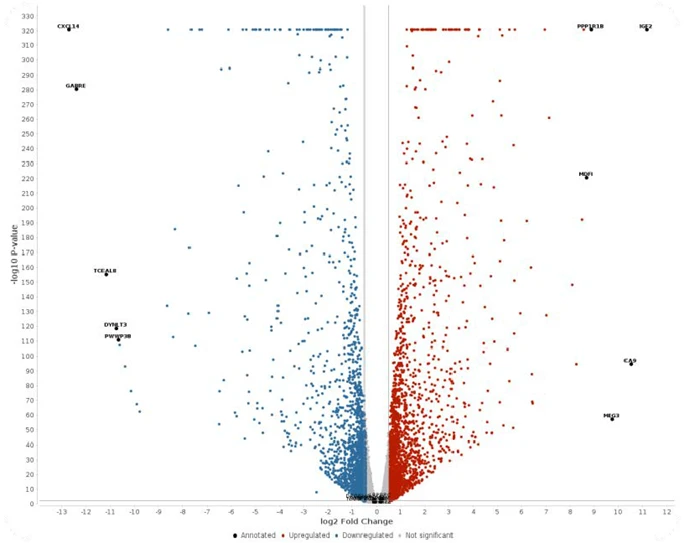
A volcano plot is a graphical representation commonly used in differential gene expression studies to simultaneously display the magnitude of expression change and its statistical significance. The x-axis reflects log₂ fold change, indicating the direction and extent of regulation, while the y-axis shows −log₁₀ of the p-value, representing statistical confidence. This visualization enables rapid identification of differentially expressed genes.
TRANSFAC PATHWAYS
(featuring TRANSFAC® 2.0 2025.2, TRANSPATH® 2025.2, the geneXplain® platform 7.7, and the Pathway Omics Suite 3.6)

Pathway Omics Suite 3.6
Multi-omics to causal mechanisms · master regulators
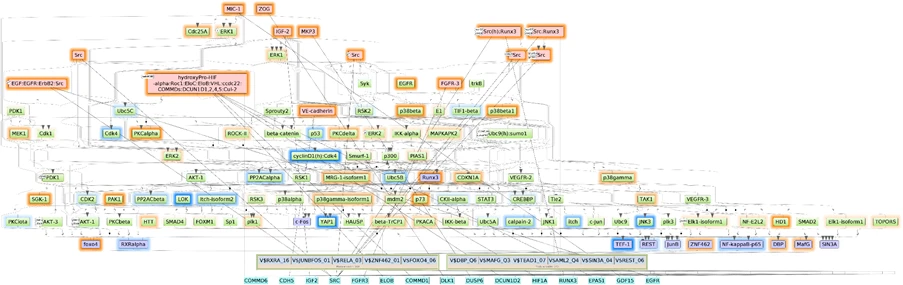
One of the highlights of the 2025.2 release is the introduction of the Pathway Omics Suite, an integrated pipeline designed to transform raw multi-omics datasets into clear, causal biological mechanisms. Designed for biologists, translational researchers, and drug-discovery teams, it reveals master regulators — the key molecules that drive disease-specific regulatory cascades.
01
New end-to-end multi-omics workflow
Built for both translational research and systems biology, the Suite offers:
02
Now part of the TRANSFAC Pathways package
With its no-coding interface and the power of curated molecular knowledge, the Pathway Omics Suite accelerates target discovery, biomarker identification, and hypothesis generation — from minutes to insights. With this release it becomes an indispensable part of the TRANSFAC Pathways package.
Protein Genome Map 2025.2
New database · protein functional features in genome coordinates
This release also marks the launch of a new database: the Protein Genome Map.
01
Post-translational modifications in genome coordinates
The Protein Genome Map is a database of genomic coordinates of protein functional features derived from high quality, manual curation in TRANSPATH® as well as additional sources. The focus is on known post-translational modifications. With this novel resource, curated information now becomes available for functional genomics investigations such as variant effect analysis.
02
Queried with “Create protein feature track”
The method extracts genomic intervals encoding protein functional features that overlap genome coordinates of interest into a geneXplain® platform track, which can then be exported or further analyzed with the platform’s portfolio of tools and workflows.
TRANSFAC DISEASES
(featuring TRANSFAC® 2.0 2025.2, TRANSPATH® 2025.2, HumanPSD™ 2025.2, the geneXplain® platform 7.7 and Genome Enhancer 3.7)

Genome Enhancer release 3.7
Automated multi-omics analysis · master regulators · drug targets · compounds
The Genome Enhancer tool in its new release 3.7 contains the following new features:
01
New expert settings
Genome Enhancer now includes several new parameters in the Expert settings. Users can customize previously fixed defaults, allowing them to define preferred statistical cut-offs, filtering criteria, the size and number of promoters used for analysis, as well as parameters governing epigenomic and transcriptomic interactions.
02
Enhanced CpG DNA methylation analysis
Integrated assessment of CpG hyper- and hypomethylated regions alongside differentially expressed genes (DEGs).
03
Demo reports updated to release 3.7
All Genome Enhancer demo reports have been updated to Release 3.7, ensuring full compatibility with the latest pipelines, databases, and interface features.
Interested in licensing our products?
Find out the prices for the products of your interest.